KSUN · 19.81 · The New Sun · essay ·
A Whole Wall of Gears
Lev AC Rosen's All Men of Genius, a steampunk Oscar Wilde with a school that runs on gears.
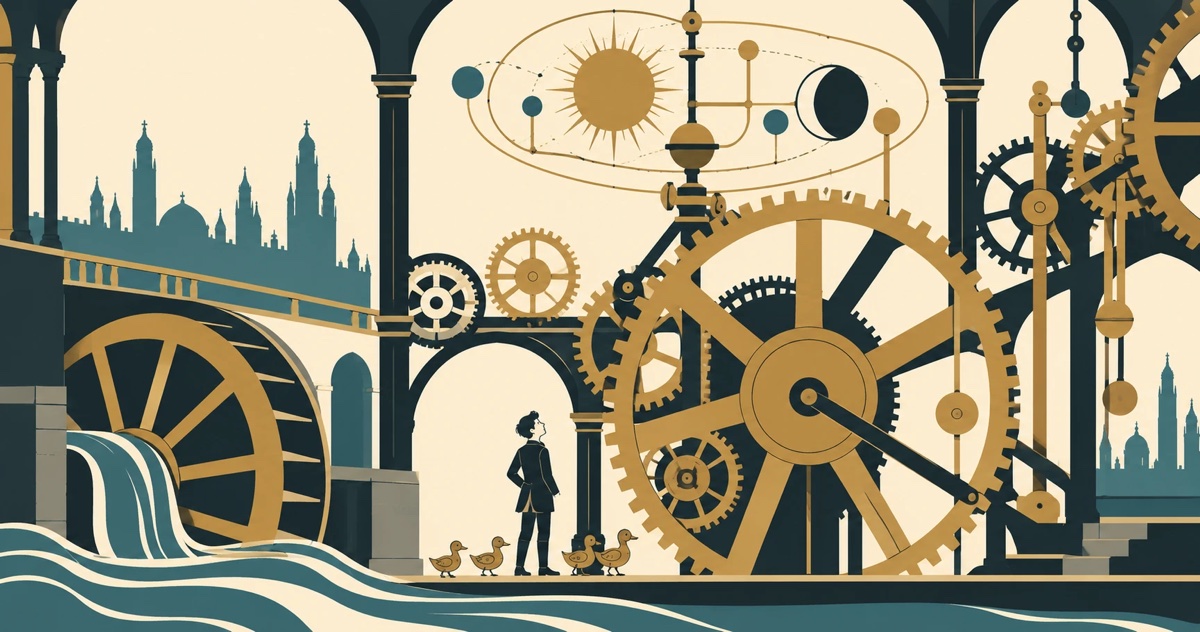
I spent twenty minutes this morning watching the Jour Nuit orrery turn on my screen, the sun and moon riding their gears around the dial, and somewhere in there I thought of Illyria College. Illyria is the school in Lev AC Rosen's All Men of Genius, which I read a few months ago, and it has a wall. The wall runs from the lowest level of the college to the top, and it's covered with hundreds and hundreds of gears. A river turns a waterwheel, the waterwheel turns a great gilded gear, and from there the gears drive everything in the place, the lift, the calculating engines, and whatever the students are building that week, which they hook straight into the system. The old duke designed it. The orrery could have come off that wall.
Violet
The book came out from Tor in 2011. It was Rosen's first novel, and it's two plays at once. Violet Adams is seventeen and a gifted inventor, and Illyria, the city's great school for science, admits only men. So she enrolls as her twin brother, Ashton, and plans to reveal herself at the end-of-year faire, once her work has shown what a woman can do. That's Twelfth Night, Viola dressed as a boy, with the duke who runs the place named Ernest, and the Earnest is the other play, The Importance of Being Earnest. The duke's ward is Cecily. Professor Bunburry is real this time, and he keeps hurting himself. Lady Bracknell teaches astronomy. If you know the plays you'll see the shape of the plot from a long way off, and the reviewers in 2011 all said so. I didn't mind, and neither did most of them, because the voice carries it.
The writing reads like Wilde if Wilde had been handed a steam engine, quick and arch and fond of everyone, with a narrator who stands just outside the characters and says the things they can't say in a Victorian drawing room.
The inventions
But most of all I read it for the machines. The first thing Violet builds for us is a perambulator, a baby carriage that folds into a handbag at the flip of a switch. It has a safety catch that won't let it fold with more than a pound and a half inside, so nobody's baby ends up in the handbag, which is Rosen's joke on the handbag in Earnest. It's clever, it's practical, and it shows you in one scene what kind of mind is about to walk into Illyria disguised as her brother.
The college is full of them. Violet makes clockwork ducklings with real feathers that follow each other in a line by magnets, with no strings. Her friend Jack makes flying ferrets, and one of them steals bacon in the middle of his entrance interview. Bunburry has built himself a clockwork hand, a metal neck brace, and a metal foot, one for each accident. Professor Prism wears spectacles with colored lenses that flip down on hinges. You can tell who people are by what they build. Violet's machines solve problems. Jack's are pranks. Bunburry's are repairs to himself. The old duke's seem to be in the cellar.
That's where the first day goes. Illyria has a hazing tradition, and the new students have to cross the basement in the dark, a maze of corridors full of abandoned automata, some of them broken, some of them still running, and some of them built to kill. It's the scene where the comedy turns a little cold. Someone made those machines and left them down there.
Mean robots and better ones
The plot is a classic. The bad people build mean tech, robots meant to hurt people, and the good gals build better tech and save the day. A second-year named Malcolm Volio, who is Malvolio split in two, wants the school and Cecily both, and behind him there's a secret society of scientists with larger plans. It ends at the Crystal Palace, with Queen Victoria herself there for the final exam.
Historical people turn up, and Ada Byron is the cameo I liked most. She's a working inventor at the top of her field, and she smokes and plays cards and drinks, and the book treats all of that as ordinary. It's a world where Babbage's engines got built, and Rosen gives Ada the place in it she should have had in ours.
There's a lot of social commentary. Violet can go to prison if she's found out, and the book lets that stay frightening. The women around her are all working the edges of what they're allowed, Cecily with her science, her governess Miriam who'd like to be free of marriage altogether, and Mrs. Wilks and her friend Fiona, who go into business selling an invention for women that I'll let you discover for yourself. Ashton is gay and open about it in Victorian London, with a steady partner and a sister who'd never think less of him. Rosen kept all of that in the story where Shakespeare's version tidies it away.
Ashton and Ernest
Ashton is the Wilde of the book. He's a poet and the wittiest person in any room, and he's smart too, and he has a heart. They all do, except the villains. That's a large part of why I liked spending four hundred pages with them.
The conversations I liked best were between Violet, dressed as Ashton, and Duke Ernest. He finds himself drawn to this young man and doesn't know what to make of it, and she's falling for him while working hard to keep her secret, and nearly every time they talk the two of them are confused in opposite directions. Rosen plays it for comedy and for tenderness both, and the love story that comes out of it is sweet and believable. Ernest courts her by letter at one point, and the letters move him to build a ship to sail the ether to the moon. I borrowed that ship for the name of a film I'm making, the ether ship.
The wall
Rosen once said he loves gears and that this book has a whole wall of them. I could tell. After I finished writing this I went back to watching the orrery.
Sources: Lev AC Rosen, All Men of Genius (Tor, 2011), and the opening chapters Tor published as an excerpt. Reviews consulted: The A.V. Club (Jason Heller, 2011), Reactor/Tor.com (Lee Mandelo, 2011), Kirkus Reviews, Library Journal, and The Book Smugglers. Rosen on gears: his 2011 guest post at Fantasy Book Café.
Related: Jour Nuit, the orrery that sent me back to this book, and A Tad Out of My Price Range, about the watch behind it and the gears I counted.