Fiction / Looking Back · essay ·
Deux Fois
A poet in a parked car, taking dictation from the radio. Cocteau's Orphée, forty years after a friend took me to see it.
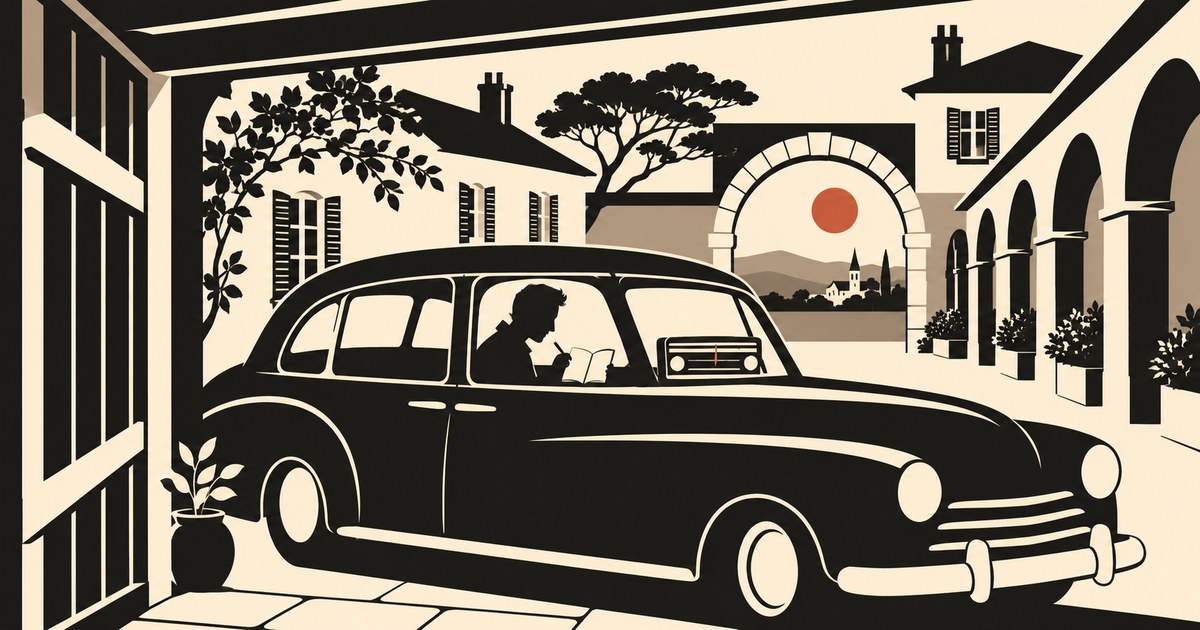
This morning I was typing track times into Mixcloud, one row of numbers after another, and a picture came back to me: a man sitting in a parked Rolls-Royce, writing down numbers off the car radio. It's Orphée, Jean Cocteau's 1950 film of the Orpheus myth, and it has had hold of me for forty years.
The Campus
I saw it first in college, on a weeknight at the Campus Theatre in Stadium Village, the same theater where I saw Fassbinder's Querelle. A friend took me, one who loved to share his knowledge of the arts. He'd seen it before, and he knew I'd love it. I did. I've seen it half a dozen times since.
The story
Orpheus is a famous poet in postwar Paris, and Jean Marais plays him. At the Café des Poètes a young poet named Cégeste gets into a brawl and is run down in the street by two motorcyclists. A Princess in black has the body put in her car and orders Orpheus in after it as a witness. María Casares plays her, and she is his Death. She falls in love with him. He falls for her, and for the radio in her car. When his wife Eurydice dies he follows her through a mirror into the underworld, stands in front of a tribunal, and gets her back on one condition, that he never look at her again.
You know how it goes from there. Everybody does, and I think that's part of why the film works on me. The story is light and already settled, so I'm free to watch. They do everything so stylishly that they could sit and listen to the radio and I'd stay in my seat.
The car
The radio in the Princess's car picks up a station no other radio gets. A flat voice reads a single line of poetry. "The bird sings with its fingers." Then it reads numbers and says how many times they'll come. "Thirty-eight, thirty-nine, forty. Twice." In the film's French that last word is deux fois. It sounds like a shortwave station meant for one listener. Cocteau took the idea from the coded messages the BBC sent to the French Resistance during the war.
Orpheus decides these are the best lines he has ever heard. The car ends up in his garage, and he sits in it day after day with a notebook, writing down whatever comes, while Eurydice waits in the house with news she can't get him to hear. The messages come from Cégeste, the boy from the café, broadcasting from the other side, and Orpheus has no idea.
That's the picture I'd keep from the whole film. Jean Marais in a black Rolls, listening and writing, and I'm glued to him. To Eurydice it's noise from the garage. He hears the best lines of his life, because of who he was when he sat down. Later, in that same car, one glance in the rear-view mirror costs him his wife.
Like a ballet
The rest comes back in flashes. Orpheus pulls on a pair of rubber gloves and his hands go into a mirror as if it were water. In the underworld, which Cocteau shot in the bombed ruins of a military academy, he trudges forward while his guide glides ahead of him. The two motorcyclists come back for Eurydice. The Princess walks into his bedroom at night and watches him sleep. He chases her through the streets and arcades of the town and she is always one corner ahead. Every face is lit like a statue.
It felt like a ballet to me that first night, and it still does. It's complicated and graceful, and everyone arrives on their mark. The passion is there in every moment, and it's held. Cocteau wrote ballets before he made films, and I didn't know that in my seat at the Campus, but I could see it.
The tricks are simple. The mirror is a vat of mercury. The gloves fly onto his hands because the film is running backward. Nobody on screen is amazed by any of it. Death has a chauffeur and paperwork and judges to answer to, and they go about their business, so the amazement is left to me.
The company it keeps
A few other films do this to me. Fellini's 8½ is one, and the Fassbinder films I've seen are others, starting with Querelle in that same theater. Serious films, full of vivid people. I'm a moth to that flame. My friend could see that about me before I'd seen a frame of it.
Two more
Orphée is the middle film of three. Cocteau made The Blood of a Poet in 1930 and Testament of Orpheus in 1960, and I haven't seen either one. I'm going to fix that, and then I'll write about all three.