Fiction · fairy tale ·
What the Tea Kept
In a country where tea keeps whatever happens to it, a young muleteer carries the Emperor's tribute north through half a year of rain.
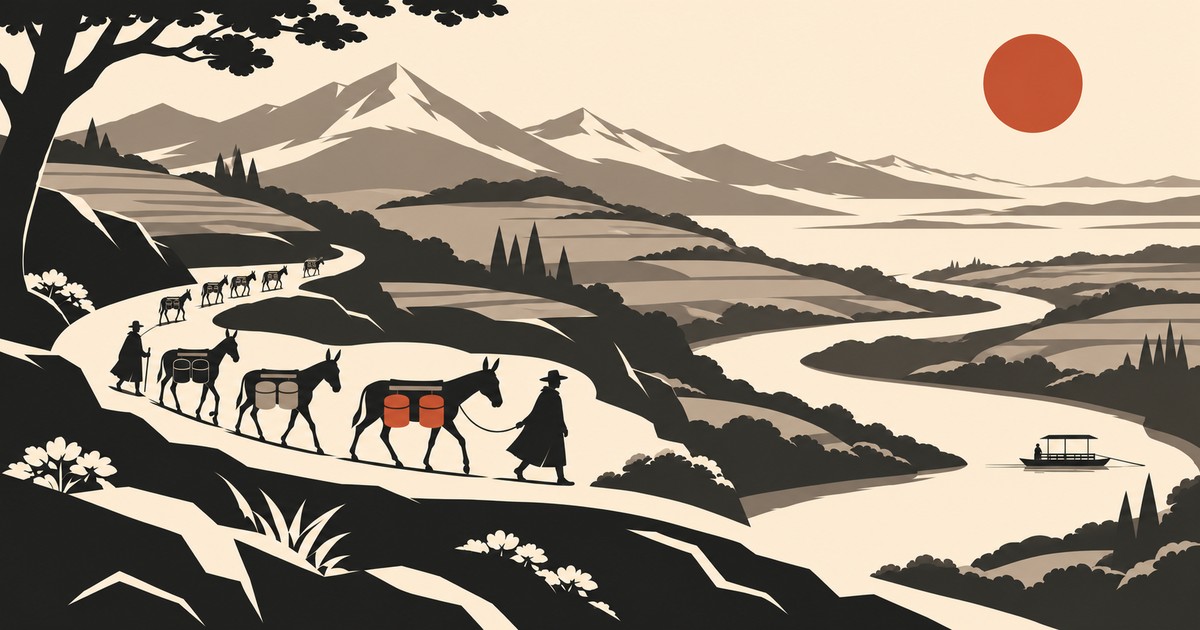
In the country of the Six Mountains, tea had a gift that everyone knew about and few people thought about: it kept what happened to it. A leaf picked at sunrise kept the sunrise. A leaf picked by a girl who was singing kept a little of the song, and an old grower could drink a cup and tell you which of his daughters had been in the rows that morning, and whether she was happy.
For this reason the Emperor's tea was picked in a single hour on a single clear morning in spring, by pickers who had been told to think of nothing. It was pressed into cakes, wrapped in bamboo husk, and carried north to the Silent City, so that the Emperor could taste one clean morning on a mountain he would never see.
The Silent City lay half a year's walk away. Inside its walls no one spoke above a whisper and no bell was ever rung. The custom was older than the dynasty. It was held that an emperor must hear his country clearly, and that he could only do so in quiet. Over the generations the quiet had been kept so well that very little reached it.
In the year of this story the tribute was given to a young muleteer named Wen, who wished to do one thing in his life without a fault. The old woman who pressed the cakes put the last of them into his hands herself.
"It will keep whatever you give it," she said. "So give it nothing."
Wen promised. He had forty mules, eleven drivers, and a clear sky.
The rain began on the ninth day. It came through the oilcloth and then through the bamboo husk. Wen walked beside the lead mule and tried to think of nothing, and thought about rain. In the river valleys the air was so wet that nothing dried, and the tea took in the heat, the smoke of the fires, and the smell of forty mules. One night he unwrapped a cake and found it had gone the brown of a wet saddle. He held it to his ear, as the growers did, and heard very faintly the river they had crossed that week.
He wrapped it up again and went down to the water alone. He meant to find the place where it had gone wrong, the way a man looks for the end of a rope. The rain had come from a sea he had never seen. The clerk had chosen the day of departure because of a festival, and the festival had been set by the moon. The mules walked at the pace their mothers had walked. His own care, which had failed, he had from the old caravan master who trained him, who had it from a father who beat him for carelessness. Wen followed each strand as far as he could, and each one led back into another, and by morning he had found no end to hold anyone by, himself included.
He loaded the mules without having slept, and walked all day, and that night he slept well. After that he stopped trying to think of nothing, since the tea was keeping everything anyway, and he began to look around.
So the tea kept a ferry woman who saw how wet he was and waved away his coin. It kept a child who ran beside the mules for a mile, asking their names. It kept old Hu, the eldest driver, who took a fever in the hill country and was carried for eleven days on the gentlest mule, which slowed the whole caravan and which nobody complained about. It kept snow on the high pass and the first sight of the northern plain. Under all of it, it kept a young man's fear, walking north one step at a time.
In the Silent City the tea master broke open a cake and went pale. There was a law about spoiled tribute, and it was a short law. But the Emperor was waiting for his morning and there was nothing else to give him, so the tea master brewed it with shaking hands and carried it in.
The Emperor was young and had never been outside the walls. He drank, and rain fell on him in the dry room. He smelled mules. He heard a ferry rope creak and a child asking names. He felt the weight of a sick man on an animal's back and the patience of eleven days. He felt the cold of the pass. And he felt the fear, all six months of it, coming toward him. He sat for a long time, and for once the quiet of the Silent City had something in it.
Then he sent for the muleteer.
Wen knelt and whispered that he had promised to deliver the tea as it was, and had failed.
"Tell me who made this," the Emperor said.
Wen had practiced the answer by the river. He named the rain and the sea behind it. He named the clerk, the festival, the moon, the mules and their mothers, old Hu's fever, the ferry woman.
"And you?"
"I walked, Majesty. I was the part of the road that had legs."
The Emperor laughed, a good deal louder than a whisper, and the tea master dropped a lid.
He had tasted every step that brought Wen to that floor, and had found none where Wen could have stepped differently. Sitting there with the cup, he saw that the same was true of the throne. A grandfather's war had carried him to it, and a father's early death, and a birth he had no say in. All his life he had been told that he was where the orders began. Now he understood that he was a stretch of the same road.
He did two things. He ordered that the tribute come every year by the slow road, and that the drivers be told to notice whatever they could. And he added a line to the law of his country: before any person was judged, the judge must first drink tea that had travelled a season in that person's coat. It is recorded that sentences grew lighter in his reign, and that the judges slept worse for some years, and then better.
Wen walked the road forty times. On the last journey a new driver asked him what a person ought to think about on the way.
"Whatever's there," Wen said.
When he was too old for the road, a package came from the Silent City: one cake from the first year, kept all that time. He brewed it on a cold evening. The rain was in it, and the ferry, and old Hu, who was long dead and for one cup was riding the gentle mule again. The fear was in it too, the fear of a young man who believed he had ruined everything. Wen found he felt toward that young man what the Emperor had felt.
Then he finished the pot, because it was very good tea.