KMAK · 20.18 · The Work Bench · essay ·
The Structure Answers
An acoustics lab built Stonehenge at one-twelfth scale and asked it a question. The answer was four decibels, and it only came back once the ring was whole.
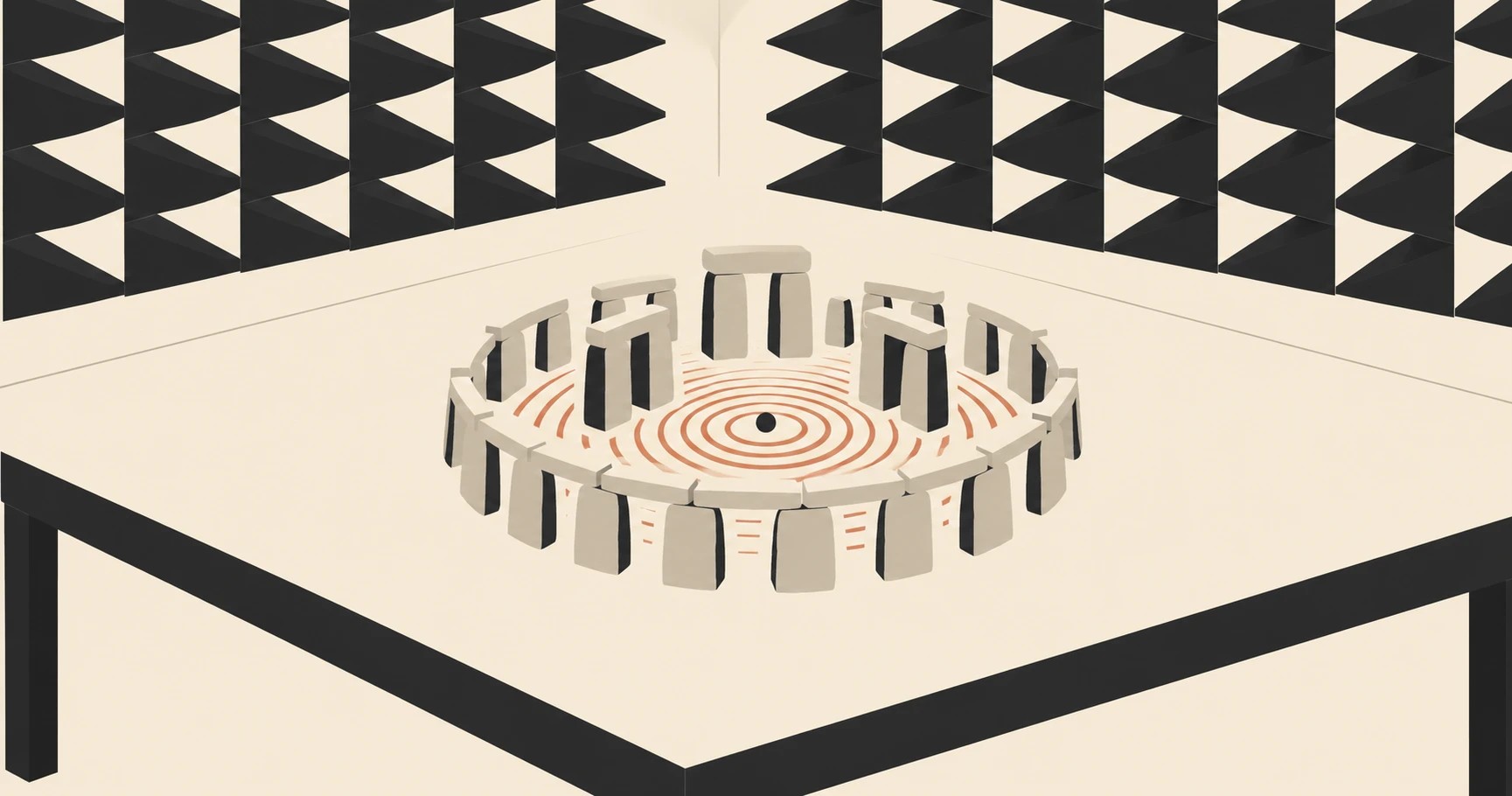
In 2020 an acoustics professor near Manchester built Stonehenge on a tabletop. Trevor Cox and his team at the University of Salford took the laser scans of the real stones, printed twenty-seven of them at one-twelfth size, made silicone molds, and cast plaster copies until they had a hundred and fifty-seven. They set the stones out the way the monument stood around 2200 BC, when it was whole, on a disc about eight and a half feet across, inside a chamber whose walls are foam wedges that swallow sound the way open country does. Then they did what you do to a concert hall before you build it. They played sounds into the model and listened to what came back.
The trick with a scale model is that sound has to shrink too. A note that would roll around the real circle has a wavelength longer than a person; in the model it has to be a twelfth of that, so the test tones were pitched twelve times higher, up where only bats and microphones can hear them. Get that right and the little plaster ring behaves, acoustically, like the real one. It's the same reason a model wing in a wind tunnel tells you how the real one will fly.
Three answers
The ring answered three things.
A voice inside the circle came back louder. About four decibels, which is the difference between someone speaking across a room and someone speaking at your table. The stones also held the sound for about six-tenths of a second after it stopped, which is a warm, short reverberation, longer than a living room, shorter than a church. Speech stays clear in a room like that. A drum sounds bigger than it is.
The sound stayed inside. Microphones placed outside the ring heard much less than those within it. Whatever happened at Stonehenge, the people standing outside the stones were mostly cut off from it. The circle made a room, and the room had an inside.
And the builders weren't tuning it. Stonehenge was rearranged several times over its centuries of use; the smaller bluestones were moved from one pattern to another. Cox's team tried the different arrangements in the model and could hear no difference. Whoever moved those stones was after something else, the sun most likely, since the monument's long axis points at the midsummer sunrise and the midwinter sunset. The acoustics came along with the architecture. They built an observatory and got a room for the voice for free.
What I find super interesting
The tagline at the bottom of every page on this site is "the signal knocks, the structure answers." I wrote it about ideas, about how a thought arrives and what you've built in yourself decides what gets answered. Cox measured it. A voice knocks, a ring of stones answers, four decibels louder and six-tenths of a second longer. It's a line about the mind that turns out to be a line about masonry, too.
Then the threads start crossing.
The Observatory, where I point telescopes from a browser, is one station on this site. Cox's conclusion is that Stonehenge answered the sky first and the voice second. The builders lined it up on the solstices and the room came with it. One structure, two signals.
The Work Bench, where this piece lives, is where I'm building speakers. Flight, Tiara and Reflect are small sculptures whose whole job is to take a signal and answer it in a shape I like. Cox built a hundred and fifty-seven plaster stones to ask a question about sound. I'm building three enclosures to listen to it. Same move, different scale, and his came off a 3D printer, which is the tool I'll be using, too.
The model itself is the part that got me. Cox couldn't ask the ruin, because so many stones are gone or fallen that the real site barely echoes. So he built a small true copy that carried the physics and asked that instead. I do a version of this every week now without thinking of it that way. When I stack telescope frames, I line them up on the stars and let the noise cancel; when I measure the supernova, I compare it to catalog stars in the same frame. You build the reduced thing that keeps what matters and interrogate it. The answer is only as good as what the model kept, and his kept the shape of the stones, which was the thing that mattered.
And the voice. The artificial intelligence is in Cox's other work: a book that follows the human voice from Neanderthals to machines, and talks he gave in 2019 saying that cloning a voice would soon be as easy as retouching a photograph. He was right. The essays on this site have a Listen button, and the voice reading them is mine, cloned by a machine, saying words I wrote. A ring of stones made a voice carry in 2200 BC. A model in a lab let us hear that again in 2020. A machine carries mine now.
Standing whole
The sound didn't leave the circle. That's the part of the study I like best, and it's also why the model had to exist. Stonehenge today barely answers at all. Too many stones are down or gone, and a voice in the ruin goes straight out across the plain. Measurements in the ruin, and at a full-size concrete copy of the monument in Washington State, hold a sound for less time than the plaster ring did. Cox couldn't get the answer from what's left, so he put the ring back together at a twelfth of the size and asked again. The ring, standing whole, answered.
Addendum: how a plaster ring can tell the truth
The idea behind a scale model is that sound doesn't care about size, only about proportion. What a wall does to a sound depends on how big the wall is compared with the wavelength. Make the stones a twelfth the size and the wavelengths have to be a twelfth as long, which means the frequencies have to be twelve times higher. A 1,000 hertz tone in the real circle becomes 12,000 hertz in the model. The range of human hearing, roughly 20 to 20,000 hertz, becomes 240 to 240,000, most of it ultrasonic, so the team played and recorded with equipment built for frequencies no one can hear, then divided everything by twelve to read the results. Done right, the model's echoes are the real echoes, sped up.
That only works if the surfaces behave the way the originals do at the scaled pitch, and this is where Cox's team was careful. The stones didn't need to be stone. What matters is how well a surface reflects sound, and sarsen and bluestone reflect nearly all of it. So the printed stones were plastic shells backfilled with concrete for weight, the cast ones a plaster and polymer mix, and every one was sealed with automotive spray paint so sound couldn't soak into surface pores. The ground is the same problem in reverse. Real grass at 12,000 hertz absorbs far too much to stand in for grass at 1,000, so the tabletop was medium-density fiberboard, chosen because its absorption at the model's frequencies matches turf at the real ones. The foam wedges on the chamber walls stand in for the open plain, which reflects almost nothing back. One more correction belongs in the list: air itself soaks up high frequencies far more than low ones, so measurements made at twelve times the pitch have to be adjusted for that extra loss, a standard step in scale-model work.
The geometry came from Historic England's laser scans and its reconstruction of the monument around 2200 BC, when the sarsen circle and the inner horseshoe were complete. The results are averages over many source and listener positions inside and outside the ring, which is why they are quoted with margins: speech gain 4.3 decibels, give or take 0.9; mid-frequency reverberation 0.64 seconds, give or take 0.03. For comparison, measurements in today's ruin, and at the full-size concrete copy at Maryhill in Washington State, both hold a sound for less time than the model did, because so much of the original ring is missing from one and the materials and surroundings differ at the other. The bluestone test was the same model with the small stones moved between their known arrangements; no arrangement changed the numbers enough to hear.
Sources: the study is Cox, Fazenda and Greaney, "Using scale modelling to assess the prehistoric acoustics of Stonehenge," Journal of Archaeological Science, 2020. Cox describes the build on his own site, with photographs of the plaster ring in the chamber; Physics Today has his short account of the physics, and Science News covered the results. Cox's book on the voice is Now You're Talking (2018).
Related: This One Works, the speakers; Every Continent, the telescopes; For Headphones Only, the listening.